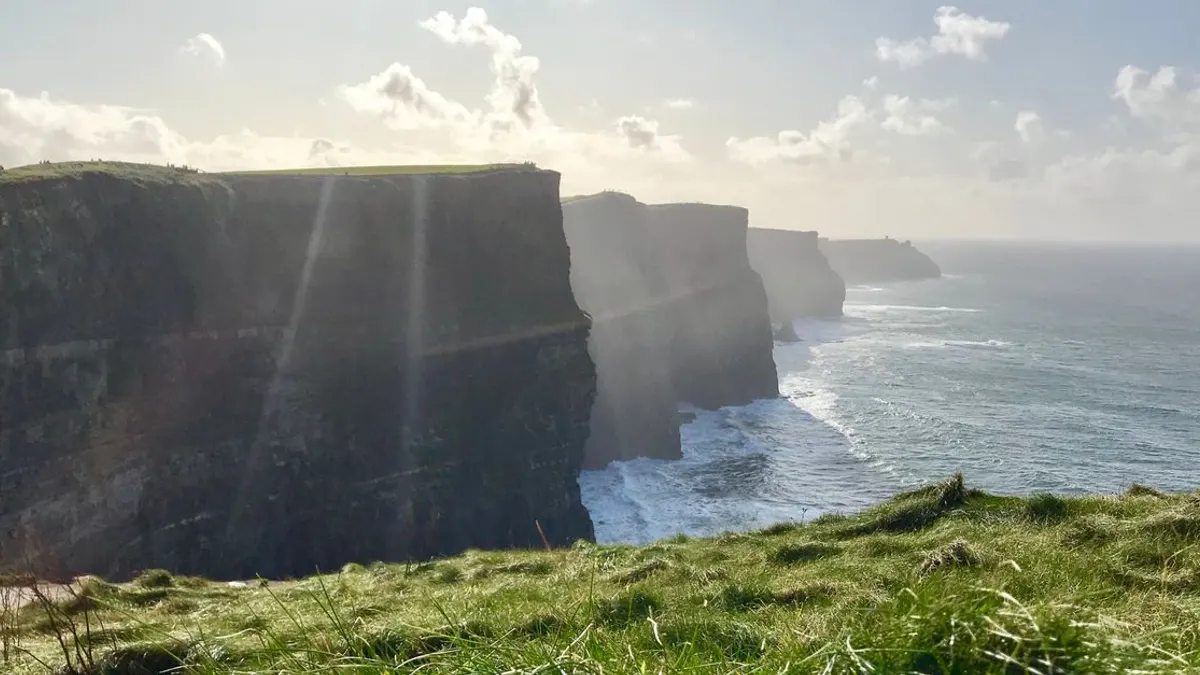
Visiting the Cliffs of Moher
Few landscapes in Ireland stop you in your tracks quite like the Cliffs of Moher. Rising 214 metres above the Atlantic at their highest point, these sea cliffs stretch for 14 kilometres along the County Clare coastline — and on a clear day, the views across Galway Bay to the Aran Islands and the mountains of Connemara are simply unforgettable.
This guide covers everything from parking and viewpoints to the best time of year to visit, so you can make the most of one of Ireland’s most dramatic natural landmarks.
Getting There
The Cliffs of Moher sit on the western edge of County Clare, roughly 70 km south-west of Galway City and about 35 km north-west of Ennis. The nearest village is Liscannor (5 km south) and the village of Doolin lies just 6 km to the north.
By car is by far the most practical option. The R478 runs directly to the main visitor centre car park at Cliffs of Moher, off the R477. There is a paid car park on site; fees vary by season but budget around €8 per vehicle. Note that the road from Doolin to the site is narrow — take care on blind bends.
By bus from Galway, Bus Éireann and various private operators run day-trip services during summer. From Ennis, the 350 route serves Liscannor, and it is a short walk or taxi ride from there.
From Dublin, the most common route combines a drive or coach transfer via Limerick or Shannon.
The Visitor Experience
The main Cliffs of Moher Visitor Experience is built partially underground into the hillside — an intentional design to minimise visual impact on the landscape. Inside you will find geology and wildlife exhibits, a café, and toilets. Entry to the site and car park is included in the parking fee; there is no additional admission charge for the cliffs themselves.
From the visitor centre, two paved cliff-top paths lead north and south. The O’Brien’s Tower viewpoint, a 19th-century lookout folly built by landowner Cornelius O’Brien, sits roughly 200 metres north of the main centre and is the most photographed spot. A small separate fee applies to enter the tower itself, though the surrounding viewing platform is free.
Walking south along the cliff edge towards Hag’s Head takes you away from the crowds and offers arguably more impressive perspectives — the full sweep of the cliffs comes into view and the Atlantic swell below is audible even on quiet days.
Safety note: Stay behind the safety barriers at all times. Cliff edges can be unstable, and conditions change rapidly. Several serious accidents have occurred over the years when visitors strayed onto unofficial paths.
Wildlife at the Cliffs
The Cliffs of Moher host one of Ireland’s most important seabird colonies. Between April and August, you can observe:
- Atlantic puffins (nesting in burrows on the lower cliff faces)
- Razorbills and guillemots in dense, noisy colonies
- Peregrine falcons hunting along the cliff edge
- Choughs — red-billed members of the crow family, a species in decline elsewhere in Europe
Bring binoculars. The cliff face opposite O’Brien’s Tower is particularly good for scanning the ledges.
Combining with Nearby Attractions
The Cliffs of Moher sit within the broader Burren & Cliffs of Moher UNESCO Global Geopark, and the surrounding area rewards a slower pace. Combine your visit with:
- The Burren — a vast karst limestone plateau immediately to the north, rich in wildflowers and prehistoric monuments, including the Poulnabrone Dolmen
- Doolin — a small village just 6 km north, famous for its traditional music sessions and the departure point for ferry trips to the Aran Islands. Doolin is also the best base if you want to walk the cliff path rather than drive
- Lisdoonvarna — Ireland’s celebrated matchmaking festival town, 10 km north, and a pleasant lunch stop
If you are touring the Wild Atlantic Way, the Cliffs of Moher form one of its iconic signature discovery points. Heading south towards the Loop Head Peninsula, or north into County Galway via the coast road, makes for one of Ireland’s finest drives.
Where to Stay Near the Cliffs of Moher
Doolin is the natural base for an overnight stay close to the cliffs — it has a good range of guesthouses, hostels, and self-catering cottages, and the traditional pub scene makes evenings genuinely memorable. Read our full guide to staying near the Cliffs of Moher: Doolin & Around.
Ennis, the county town of Clare, offers a wider range of hotels and is 35 km away — a reasonable drive after an evening meal. See our picks in County Clare accommodation.
Galway City is popular for those combining the cliffs with a city stay — it is about an hour’s drive and has accommodation to suit every budget.
When to Book
Summer (June to August) is peak season at the Cliffs of Moher, with the car park filling by mid-morning on sunny days. The shoulder months of May and September offer similar daylight hours with noticeably thinner crowds. Winter visits can be extraordinary — stormy Atlantic swells and dramatic cloud formations — but some facilities operate reduced hours.
If you are visiting in July or August, book accommodation in Doolin well in advance. Properties in this small village sell out quickly, and availability from January onwards is typical for the best-value options. Search and book early to avoid inflated last-minute prices.
FAQ
Do you need to book tickets for the Cliffs of Moher in advance? There is no timed-entry ticket system — the cliffs are open to all visitors who pay the car park fee. However, on busy summer days, the car park can fill by late morning, so arriving before 9 a.m. or after 4 p.m. helps you avoid queues.
How long should you allow for a visit? Most visitors spend between one and two hours at the site itself. If you walk south to Hag’s Head and back (around 6 km return), allow three hours minimum. A full day is worthwhile if you combine the cliffs with Doolin and the Burren.
Is the Cliffs of Moher cliff walk suitable for children? Yes, the main paved paths are manageable for older children, and the visitor centre is family-friendly. Keep young children close to you at all times near the barriers, and note that the unpaved sections south of the main viewing area are unsuitable for pushchairs.
Related: Staying near the Cliffs of Moher: Doolin & Around · Wild Atlantic Way Accommodation · Where to Stay in County Clare